Monday, October 24, 2011

Mini-Quiz on "The Case of Four and Twenty Blackbirds"


Today we had a quiz on this quirky, dark comedy.  From what I saw, many of you had difficulty in identifying the CENTRAL CONFLICT of the story (Detective Jack Horner vs. The Queen of Hearts).

This is the beginning of our reviewing for a cumulative test on short stories and short story terms.

Homework:  Short Story test on FRIDAY!  This is a big one, kiddos.

Friday, October 21, 2011

"The Case of Four and Twenty Blackbirds"

Here are some links to short stories that you should know to get the most out of this weekend's story!  Click on the picture to find out even more information about the nursery rhymes!


Here is the story itself:  "The Case of Four and Twenty Blackbirds"


Here is a nursery rhyme link to "Who Killed Cock Robin" ... that gives away the killer!


Here is the one that the story is based on and explains what happened to the queen (Four and Twenty Blackbirds)  

And of course, here is (Humpty Dumpty)


Now, for further investigation, here is the link for "film noir" a genre of film, and stories, were there is usually mystery and murder, and it is always rainy and dark out.


Short Stories and Finishing the Storybirds!

Okay, enough with the NECAP's.  Let's finish off the storybirds!

Of course we will go over last night's homework - which you guys obviously need work on!

Also, today we will pass out the writing folders, and many papers will get passed back.  Any writing assignments will get put in there!


Homework:  Read the second-to-last short story that we'll read this year: "The Case of Four and Twenty Blackbirds."  There is a mini-quiz on Monday identifying the narrator, central conflict, an example of irony, and tone of the narrator.

Thursday, October 20, 2011

NECAP days 7 and 8: The five-paragraph essay!

These are the last two days of the NECAP writing test - the hardest of the three tests!  The final part of the test expects you to fill THREE whole NECAP pages with writing - and get this - they expect you to know it should be in a 5-paragraph essay format!

So, in class, we are reviewing the 5-paragraph format, which I'm surprised how little you remember, being that it was drilled into your head for at least two years!

We will talk about how the 5P essay is different from "real-world" essays, and why it is still important to know how to do it, and what the elements of it are.

Homework:  Do the 5P essay outline for the question "What would an ancient Roman find similar and different from writing today?"


Special:  Tom needs a new alarm clock!  Click here to donate to the "Bacon Clock for Tom" foundation.

Tuesday, October 18, 2011

NECAP, DAY 6, Writing Test Strategies

Hi Folks,

Today is the last math NECAP test day.  All week we are on a block schedule until Friday, when the NECAP's are all done and we return to a regular schedule!

We reviewed and shared the NECAP dialog writing prompt, and you were given two more writing prompts from last year's NECAP writing test (released items).

First one (narrative):  Write a paragraph from an adventure story, that introduces your main character (protagonist) and gives them LOTS of characterization.

Second one (persuasive):  Write a paragraph that takes a postion on whether or not we should have a class in school that teaches kids how to save and manage money.  Give one good reason and elaborate upon it.


Homework:  The above two prompts.  Remember: fill the box!

NECAP: DAY 5, The Rules of Dialog(ue)


Well, good morning folks!

For class today, in preparation for NECAP writing tests, we will be going over the basic rules of dialog.  We went over some basic rules for quotation marks, and how they are used with dialog, but if you want an extensive list of rules, check this site out.

Homework:  Do the NECAP writing exercise (the dialog with the girl talking on the phone).

Friday, October 14, 2011

Win a Free Laptop for Writing Haikus

Okay, okay...they are not REAL haikus, because REAL haikus traditionally involve a meditation on nature and the seasons....but what the heck...free computer, right?

Remember: haikus have 5 syllables the first line, 7 the second line, and 5 the third line.

Example:  
Winter is coming:
Time to gather fire wood,
and stories to last.

Submit your own on the link below...or just for fun, you can comment on this page.


NECAP: Day 4 and Block day

Okay Friends,

Today is another block day with NECAPs.  Since everyone finished the reading portion of the test, the classes today will be having different homework than the classes that met yesterday.  The classes that meet today are discussing the rules of dialog(ue).

 Homework:  NECAP review homework #2 due Monday.

Thursday, October 13, 2011

NECAP: DAY 3 and Block Day

Okay True Believers,

Today is a bit of a tricky one:  Block day, and shortened periods due to NECAP's.

In class today:

Part 1:  Reviewing the reading test prep. homework

Part 2:  Assessing/Sharing your Storybirds, continued.

Homework:  More NECAP test-prep. practice - due Monday!

Wednesday, October 12, 2011

NECAP: DAY TWO

We'll take a quick break from assessing the Storybirds for today to focus specifically on how to nail the NECAP reading test.

Best way to attack the reading test:

  1. Read the questions first...especially the long-response questions!
  2. Highlight/underline/circle information from the passage that can answer the questions...and quotes you can use for your long-response!
  3. Set up your paragraph
    • topic sentences
    • body that has specific information and PQE
    • concluding sentence
  4. Reread the long-response question while you write to make sure you don't ramble.
Fill the BOX!

Homework:  Finish the Necap test prep "Town Animal Pounds"

Oh, and don't forget to vote for us on the GLEE website!  You can vote once a day!


Tuesday, October 11, 2011

VOTE FOR OUR SCHOOL on GLEE!

Go here and vote for your favorite school, narrated by your favorite English teacher!!

NECAP: DAY ONE

Hi folks -

Today is our first day of NECAP testing.  For 90 minutes each day, for 8 days, we will be testing.  Two tests of reading, then three math tests, and then the hardest: THREE days of writing.

A couple things to keep in mind:

  • RULE #1:  fill then entire box of text when you encounter a prompt!
  • On-team classes are only 30 minutes long.  There will be a flex period - but it'll be short.  No priority groups during these days.
  • Bring a book - if you finish your test, and have checked it twice, read.


In class today, we will be watching and assessing our Storybirds.  No homework.


FILL THE BOX!!


Friday, October 7, 2011

Sharing Storybirds

Today we are sharing our Storybirds!  Don't forget to have your rubric ready, and that it is properly filled out!

In the meantime, please feel free to check out your classmates' stories...you can read them!


Homework:  Be prepared to continue sharing Storybirds Tuesday.

Parents:  Your child's Storybird is up, please read it, and yes, you can have them published!

Thursday, October 6, 2011

Storybirds Days 3 & 4

Benchmark for day 3: 7 words included, and be sure that your protagonist is both round and dynamic.

Day 4:  This is your last in-class day to work on your Storybirds - if you don't publish in class, you need to do so at home.


Homework:  Umm.  Guess.

Tuesday, October 4, 2011

Storybird: Day 2

By the beginning of class today, you need to have firmly decided upon which "menu choices" you will write your story upon and what collection of art you are going with.  Also, if you are doing the storybird alternate assignment, you need to have firmly decided upon that as well...remember:  if you are going to choose the alternate, you are STUCK with it, and do not get extra time.

By the end of class, you needed to have incorporated 3 of the 10 vocab words into your story.  Remember:  The meaning of the word needs to be clear from the context of the rest of the sentence - someone who didn't know the meaning of the word would be able to figure it out from the rest of the sentence!  Be sure the sentence is long enough!


Homework:  Continue to work on your storybird at home.  You should have at least 5 of the ten words in your story by tonight...aka you need to be half done.

DUE DATE IS THIS FRIDAY MORNING!

Monday, October 3, 2011

Storybird: Day 1

Hi Folks,

 You were given a rubric and project description for the storybird project last Friday.  Today through Thursday we are working on it in class.  There is no homework all week, except to continue working on your project.  It is absolutely necessary to be prepared to work in class these four days, because they are due the beginning of class on Friday, when we present them to the class.

Again, we only have four days on in-class time to work on these...so you MUST NOT PROCRASTINATE!!

Homework:  continue working on your storybird!  If you didn't choose your artist in class, you must do so at home and be ready with it by the beginning of class tomorrow!

PARENTS:  Hey, your kid will have the option to publish these projects after they are done.  From past experience, these stories look quite beautiful.  However, if you wish to have your child's story printed, it does cost money.  See the storybird website for details.

Friday, September 30, 2011

Literary Analysis Paragraph

Today we are going to share our literary analysis paragraphs, sharing what is good, and what needs to be reviewed.

At the same time we will begin reviewing the stories and the terms in preparation for a test in one week and two days!

Next week we will be creating storybirds ... so get ready...it will be unlike any storybird you may have done before!

Homework: none

Thursday, September 29, 2011

What is Dr. Who?

Okay, some of you asked. The season finale is on this Saturday...and I'm really excited!

Looking Ahead: Storybird

Next week we are going to apply what we know and write a really awesome story, using a really awesome website, www.storybird.com  check it out!

Wednesday, September 28, 2011

The Secret Life of Walter Mitty, Literary Paragraph

This is a block day, don't forget!

Today we discussed how humans use the story frame as a way to store information in memory and the strange impact that has on the information (see NPR article posted below).

Afterwards, we took notes on how to write a literary analysis paragraph...not too hard, and they are great frames to store important information about a story...how convenient!  You will get to choose any story that we have read together ("All Summer In a Day," "After I Was Thrown Into the River, and Before I Drowned,""The Cask of Amontillado," "Harrison Bergeron," "An Occurrence at Owl Creek Bridge," and the one below) AND pick one term (characterization, irony, conflict) to talk about!

Homework:  Read the story, "The Secret Life of Walter Mitty" and write your literary paragraph.  Due Friday.


Okay, so there is a 12-part Youtube version of it...again, it is not exactly the same as the story, so read the story, but if you want to have some fun...check it out...I put the first installment below...but you have to find the rest if you want to watch the whole thing!

Tuesday, September 27, 2011

Reviewing the types of conflict: "Harrison Bergeron"

Today we reviewed yesterday's literary terms on satire and conflict.  We also talked about the short story, "Harrison Bergeron" and answered the question of what the author was trying to satirize.

Homework:  Read the psychologically thrilling story "An Occurrence at Owl Creek Bridge" (due tomorrow)

READ the full story here.

(Check out the video link below)

How our minds work...interesting link...

Great little radio story...listen to this!


"How Psychology Solved A WWII Shipwreck Mystery"

"An Occurrence at Owl Creek Bridge" Videos

Soooo...Alfred Hitchcock is a TOTALLY awesome director...and he tackled this famous story...in three parts.  He does change the plot...a little...so make sure you read the story, not JUST watch the videos.


Harrison Bergeron Video


It's a little corny...but kinda cool as a review.  Check it out!

Monday, September 26, 2011

Harrison Bergeron, conflict and satire

Today you will copy down some terms, and then read the satirical story, Harrison Bergeron.

Terms:

Satire - a work that ridicules the foolishness of individuals, a society, or humanity.


person vs. person conflict -  the antagonist is preventing the protagonist from reaching their goal
person vs. nature/technology conflict - some natural or man-made obstacle is preventing the protagonist from reaching their goal
person vs. group/society conflict - a group of people or society's laws/rules/expectations are preventing the protagonist from reaching their goal
person vs. self conflict - when a character is struggling over a difficult decision, a personality flaw, or a physical or mental limitation which prevents them from achieving their goal


Harrison Bergeron is a futuristic sci-fi story that supposes that everyone is given "handicaps" to make everyone in society completely equal.  Nobody is allowed to be smarter, cuter, or stronger than anyone else.  Kurt Vonnegut (the author) wrote this satirical story to poke fun of some aspect about our society...what is it?


Homework:  finish reading "Harrison Bergeron."  Be prepared to answer questions about the story on Tuesday. 

Friday, September 23, 2011

Review Terms and Discussion

We will review the terms learned so far, will discuss the story, and will have an in-class free-write:


Two options:

1) summarize the story using as many terms you know as possible (minimum of three)
or
2) modernize the story into a present-day revenge story...creepy!

Homework due Monday:
1)  finish the in-class free-write, if you have not already.  One full, hand-written page minimum.  It must be legible because it will be going into your writing folder!

Thursday, September 22, 2011

"The Cask of Amontillado," and more lit. terms ... isn't that ironic?

Today we read a story about revenge.  We will also learn some more literary terms: irony, verbal irony, dramatic irony, and situational irony, AND symbolism.  The definitions will be given in class, BUT they are already on flashcards in an earlier post (look below!)

You can read the story online here, if you prefer.

For a huge list of symbols in literature, and what they often refer to, click here.


Homework:

Finish reading "The Cask of Amontillao"


check out these videos....


Here is what the Parisian catacombs look like:


Wednesday, September 21, 2011

Literary Terms Scavenger Hunt...and REVENGE!

Now it is time to apply what we have learned!  You will be in teams of 3-5 members.  Each team gets a bingo sheet.  Only one book per person at a time.  The first team to get a three-in-a-row wins!  We will be highlighting passages from books for proof that we found the term, so be prepared.

The second half of the class will be spent beginning with reading the story, the "The Cask of Amontillado"...  a great story about revenge!  Yes, this one is a little dark!

Homework:  read the first half of the story, "The Cask of Amontillado"

Tuesday, September 20, 2011

Terms Review

Hey Folks -

Today we will review the terms about narration we learned on Monday.  Mr. Stowell selected a few stories that he really likes and read narration from them while the class went about discussing and debating what type of narrator they had.  Please note that in novels, the decision of what type of narrator isn't always %100 one type, but a mixture of two, although there usually is a dominate type.  In short stories, it's easier to tell (because they are shorter).

Here is what we determined:

Harry Potter and the Sorcerer's Stone - 3rd pers. limited.  We see inside Harry's head primarily, although there are times when we do see a little into some of the minor characters, such as the Dursleys...making it a little omniscient.

Lord of the Rings - The Fellowship of the Ring - 3rd pers. limited.  We see inside Bilbo Baggins' head frequently, although a lot of the narration is descriptive, as if seen by a "fly on the wall," making it a little objective.

Angels and Demons - 3rd pers. limited.  We see inside Langdon's head the most, who is the primary character, but to a lesser degree, we do see inside the head of his partner, Vittoria.  So, there is more than one, so you could argue that it is a little omniscient.

A Series of Unfortunate Events - The Slippery Slope - 3rd pers. omniscient.  We see inside the heads of several characters, most notably the Baudelaire children...but you could argue that the three of them almost act as a single unit, and we don't see into the heads of anyone but them, so you could argue that it could be a little limited.

The Hunger Games - 1st person.  Boom.  Easy.  This book is narrated by the protagonist, Katniss, referring to herself as "I" and we definitely see inside her head.

"The Things They Carried" - 3rd person omniscient.  This one is easy too, if you read for long enough. We see into the heads of all of the soldiers as they are on their march.  (This is one of my favorite short stories of all time, by the way, but it's about Vietnam and can be kind of graphic, so you may want to wait to high school to really read it and like it).

Tomorrow, we will go on a scavenger hunt and you will find each type of narrator!

Homework:  None.

Monday, September 19, 2011

New Literary Terms and a Great Story!

Hi Kids,

Today in class we are reading the great short story "After I Was Thrown In the River and Before I Drowned" by Dave Eggers, one of the most promising contemporary fiction writers my age.  He wrote some really cool, really famous books like The What is The What and one of my all-time favorites, A Heartbreaking Work of Staggering Genius.  This story has an interesting narrator, which I'm sure you discovered.

Also today, we covered five new literary terms:

  1. First-Person Point-of-View (p.o.v.):
  2. A character in the story is the narrator.  Readers see only what that character sees.
  3. Third-Person Omniscient p.o.v.: The narrator is "all-knowing" and tells the readers what any character thinks or feels.
  4. Third-Person Limited p.o.v.: The story is told through the eyes of only ONE character.  The reader only knows how that one character feels and thinks.
  5. Third-Person Objective p.o.v.:  The story is told as if by a "fly on the wall" without the reader being able to know the thoughts and feelings of any character.
  6. Tone:  The narrator's attitude toward the story, the characters, themselves, and even the world (i.e. pessimistic  apathetic, optimistic, happy, angry, ashamed, prideful, excited, frustrated, dark...etc.).
Two questions to ask yourself:  What kind of narrator do we have in this story?  What is the tone of that narrator?

Homework:  Finish reading the story.  Summarize it in as few sentences possible while still including the essential plot and character information AND including three literary terms (you can use the old terms as well as the ones you learned today).  Due tomorrow!

All the literary terms flashcards


Friday, September 16, 2011

The flash cards once again.

Reminder: You can go onto www.quizlet.com and search for my cards (search "Stowell").  You can also download these to any iPod Touch flashcard app that can download cards from Quizlet.


How to Coin Walk

This is related to the prompt I wrote on characterization...but it's also a brief preview of the type of project we will work on at the end of quarter 1 / beginning of quarter 2!


Vocab post-test today

Hello Folks!

Today in class is the vocabulary post-assessment that for the words that we have been studying these last two weeks.  Based off of preliminary results from first period, things are looking pretty great!

As for Parent Night last night, it was awesome!  A special thanks to all the parents who made it out!  I did ask how many of them knew you were taking a quiz today, however, and only a few hands went up in each class...let's change that; let your parents help to quiz you as you are washing the dishes after dinner!

As for the writing response you did to yesterday's short story, All Summer In a Day, I'll be collecting that on Monday, so DON'T LOSE IT in your binder (I'm looking at you, Joe)!

Homework:  None...have fun.

Looking ahead:  More literary terms and short stories next week!  Although we have ropes course, we will still be having classes.  The next story we will read has a dog as the narrator...it's hilarious, and sad, and awesome!

Thursday, September 15, 2011

Parent Night!

Tonight is "Parent Night" or "Open-House" here at C.M.S.  Hopefully, I'll get to meet a lot of your parents!  Below is a quick slide-show regarding some of the things I'd like to tell them, but mostly it will be a time for me to shake hands and say hello in my typically nerdy, over-excited way.


Wednesday, September 14, 2011

Our First Short Story..."All Summer In a Day"

WELCOME TO BLOCK-DAYS (Wednesday and Thursday)

Today, we'll start with a little vocab-baseball to get the ball rolling.
Second, we'll check and share your paragraphs on "what makes a character great."
Thirdly, we'll start our first short story, "All Summer In a Day," a cool little science-fiction that takes place on an alien planet where summer only lasts for one day out of several years.  We are going to focus on the characterization in this story.

Homework:  Write at least one paragraph (10 sentences minimum) making one of the flat antagonists more round.  Rewrite part of the story from that antagonist's point of view, turning them into the protagonist.  If you don't finish it in class, finish it at home!  Due FRIDAY!

DON'T Forget that your first Vocab post-assessment is FRIDAY as well!

Tuesday, September 13, 2011

Mr. Stowell's example of the homework!

I've been getting a few questions about the homework...so I did it myself and put up an example!

      Doc Holiday from the movie, Tombstone, is one of the greatest characters ever!  Although he is not exactly the protagonist (that role belongs to Wyatt Earp) he is given so much indirect characterization, that he almost steals the show.  Throughout the movie, Doc Holiday loves to poke fun at the bad-guys, always provoking them into a fight, which he always wins.  He is obviously the best gunslinger in Arizona.  Although he is suffering from tuberculosis, which he knows will eventually kill him, he doesn't let that stop him from having too much fun and causing too much trouble.  His character also has some really great direct characterization in the way he looks in the movie.  He is deathly skinny and pale (from his sickness) but always impeccably dressed and playing with a lucky coin that he's constantly rolling between his knuckles (when he's not shooting people).  If he were to be categorized as a dynamic/round, or static/flat character, he'd actually be a combination of the terms.  He's definitely static, because his personality never really changes; he's the loyal-to-the-end friend of Earp, and a selfish jerk to everyone else from the beginning to the end of the movie.  However, he's not exactly flat, because there is so much description of him...although we never fully know what makes him tick.  Because of these qualities, he is a very memorable and awesome character!

Okay, so I'm an over-achiever...I did 11 sentences, and included 5 terms, but there you have it!

Tech Setup.

Hi Folks,

First things first:  we got to get our computer accounts set up!  Ms. Maciolek and Mr. Descoteaux will be there to help us - do whatever they tell you to do!


So, technically, there is no English class today.  I'll be in the room, but the class will only be on setting up your computer accounts.

Homework:  Same as last night...I'll be checking homework tomorrow!

Sunday, September 11, 2011

Vocab baseball and Characterization Terms

Hello folks, happy Monday!

So, to get things started, I thought we'd have a little vocab baseball.  Two teams, two innings.  The pitch will be the pictures.  Single if you can correctly guess the word, double if you also guess the correct part of speech, triple if you can correctly use the word in a sentence, home run if you can do all that AND correctly spell the word.   This is my first time trying the game, so cross your fingers.

The second half of the class will be concerned with a discussion of characterization.  We will talk about what makes a good character great and memorable.

You will also learn some new literary terms:
  • Direct characterization - When the author states a character's traits, mostly physical
  • Indirect characterization - When a character's personality is shown by their words and actions
  • Flat/Static character - a character that who's "soul" is somewhat a mystery and remains largely unchanged.
  • Round/Dynamic character - a character who's soul and personality is well-described, and who goes through some kind of change throughout the story.
  • Protagonist - the main character, sometimes the "hero" who must overcome the main obstacles and resolve the primary conflict.
  • Antagonist - a character or force in conflict with a main character or protagonist
There will be an in-class writing about what makes a good character.  Use some of the terms and examples we have learned and talked about in class.

Homework:  Study your vocab - it won't learn itself!  Finish the in-class writing.

What's coming up:  We will read a cool short story and apply what we know about characterization tomorrow!

Friday, September 9, 2011

What makes a good character (cont.)

Today we will continue the "Who the Heck Is That?" game, in guessing our classmates' favorite characters, based off of their detailed descriptions.  Afterwards, we will have a class discussion on what really makes a great (not just good, but GREAT) character.

For Monday in-class writing:  One fat paragraph (10 sentences minimum) answering the question "what makes a good character?"  Be sure to include what you learned from today's discussion.  This may be typed or neatly in ink.  Be prepared to share.

Homework:  Study your vocab flashcards (look below for the earlier post).  Post-test is on next Friday.

For the kids who tested out:  Your vocab list of ten words is due (the whole sheet needs to be completed) by Tuesday.

It's Friday

Firstly, let me welcome you to Friday! Secondly, I want to definitively tell you that the horrible song with terrible lyrics, "Friday" by Rebecca Black, was not written by Boby Dylan, despite the fact that there is a Dylan impersonator singing a cover of it on Youtube. Sorry, Nick - I did the research. Read here, watch here.

Please see what we did in class in the next post.

Thursday, September 8, 2011

What makes a good character?

Today we will start by checking and sharing your vocab stories that you wrote in class yesterday.  Then we will briefly do some vocabulary review while the "T.O.'s" (kids who tested out) will begin setting up their vocabulary lists.

Midway through class, we will reconvene to do the "Who the Heck Is That?" character game, based off of your last night's homework.  Prizes will be given to those with the best character description, and to those who guessed the most characters correctly.  Afterwards will follow a brainstorm on what makes a good character.

Homework:  Check out the flash cards.  Begin studying vocabulary.  

Wednesday, September 7, 2011

Pretest

Good Day fellow students!

Today is the pretest.  If you pass with an 90% or better (this time) you have "tested-out" of the list and will do self-guided vocab, based off of a novel of your choosing.  If so, you need to keep a book at school during the first week of the unit to create your list of 14 words.  If you do not have a book, you will be promptly sent to the library to acquire one, and will lose time to generate your list, or you may lose your "tested-out" status.

We will correct the pretests in class, and you will know your status today in class.
  • Challenge Level:  The post-test will consist of half of the words are multiple-choice, half fill-in the blank for sentences.
  • Super-Challenge Level:  This post-test will look very similar to the pretest without the word bank, and will consist of 14 words.
  • Extreme-Challenge Level:  This post-test will provide you with a word bank, and you must write a story that correctly uses the words in context.  In addition, you must provide the correct part of speech for each word as it is used.

After the pretest, you will have an in-class writing assignment:
  • Choice 1:  Write a paragraph that uses all ten vocabulary words correctly in a scenario that describe a time where you or a loved one had "a close call."  Remember Mr. Stowell's appendectomy story?
  • Choice 2:  Write a paragraph that summarizes the Jon Krakauer story excerpt from Into Thin Air, which correctly uses all ten vocabulary words.
Homework: 
  • (Due tomorrow)  Finish your in-class writing.  Be sure to use all 10 words.
  • (Due tomorrow)  Write one paragraph describing (in as much detail as possible) your favorite character from a book or a movie.  DO NOT REVEAL THE NAME - we are going to try to guess it in class!  (Pen or pencil - as long as it's legible)
  • (For people who tested-out) Bring a book tomorrow that you can use for your vocabulary list.  If you do not bring a book, you will default to Extreme Challenge.
                                 

Tuesday, September 6, 2011

Rev It Up!

Vocab List for Unit one:

  1. Ascend    (v.) To move upward
  2. Deteriorate    (v.) To have the condition of something get worse and worse
  3. Deplete    (v.) To be completely used up
  4. Innocuous    (adj.) Harmless
  5. Banal    (adj.) Something or someone that is so common that it is boring
  6. Demure    (adj.) Quiet and shy
  7. Formidable    (adj.) Threatening because of size or strength
  8. Immaculate    (adj.) Spotlessly clean
  9. Arduous    (adj.) When something takes a lot of effort
  10. Err    (v.) To make a mistake
  11. * subordinate    * (adj.) To be lower or less than something else
  12. * pinnacle    * (n.) a high peak or point
  13. * notorious    * (adj.) well-known for having a bad reputation
  14. * benign    * (adj.) not causing harm
Starred words 11-14 are for super and extreme-challenge!

Pretest - you may test out of each list! If you do, you must bring a book to English class every day during that unit!
Today students passed in their first assignment!!  I must say, I was overwhelmingly positively impressed with the turnout...out of those present, only three students out of the entire pod were unable to pass in the assignment on time!

Also today we finished the Jon Krakauer excerpt from Into Thin Air which highlighted our upcoming vocabulary unit.  Please refer to the flashcards in the previous post.  Tomorrow there will be a pre-test on the words.  If you "test-out" of the list (you smarty-pants, you) you will be able to skip the unit and build your own vocabulary list from a book that you are currently reading.  More on this as we do it!

Homework: none, pretest tomorrow!

Wednesday, August 31, 2011

Letters and Revving it up!

Today we're continuing to talk about the format for a business letter, as explained in the last post! You have a little in-class time to continue working on it. You will get an "A" grade if you wrote 15 sentences in rough draft.

The second half of class is story-time! There is an excellent selection in the Rev It Up text, which is an excerpt of one of my favorite books (which, coincidentally, is one of the literature group titles for later this year)! So, yes, that means we will be starting the first Rev It Up vocabulary list when you get back on Tuesday. However, if you have an iPod touch and want to download flashcards for the unit to get a jump on things, the link is right here!


Homework: Final draft of business letter to Mr. Stowell due Tuesday at the beginning of class.

Getting Down to Business: The Business Letter

Today in class we continued/reviewed the name-game in order to build our class community. Afterwards, we reviewed the business letter format for your first assignment: Write Mr. Stowell a letter about yourself!

A helpful link with the format of a business letter can be found here.
Look at the first example of a letter here.

The letter will be started in class and will be finished for homework. The minimum length is 15 complete sentences....there is no maximum. It may be printed at home, or neatly written in ink. This should be in final draft form, so yes, it should be edited and most of you will have to do a second draft. Remember, I'm like your boss, you are a new hire, and this is your first impression.

Here are some possible things you might want to include in a letter:
  • Who your favorite English teacher was, and what was it about their teaching style that you found worked really well with you.
  • Do you love to read and write, or is it really laborious and tedious for you.
  • What kind of books do you like to read, and what kind of writing do you like to do?
  • What do you hope to get out of this year in English class?
  • What does an English teacher need to know about you?
  • What are your educational and/or life goals?
  • How far do you want to go in your education?
  • What are some of your good/bad student habits?
  • Are there any personal factors that affect your life as a student (positively or negatively) that you think a teacher would find helpful to know about you?
  • Do you like school? Why or why not?
  • What are some of your questions or concerns about class or school that have been on your mind?
Homework: Rough draft (15 sentences minimum) due Thursday. Final draft of business letter due the following Tuesday, at the beginning of class (typed or neatly in ink).

Tuesday, August 30, 2011

Day ONE: Done!

Today in class, Mr. Stowell told you a little about his nerdy self, and a little about the class expectations. If time permitted, we did the name-game. If not, we'll settle that tomorrow!

Class Information:
Grades/Homework assignments: Homework accounts for 10% of your grade and is considered practice. Small assignments will not be accepted late. The bulk of your grade is determined by quizzes and writing assignments. Quizzes can be retaken for the better grade after school on Mondays and Thursdays. For every day a writing assignment is late, it goes down a letter grade.

What to Bring:
Pen, paper, agenda book, binder, and any other relevant classroom materials/assignments.
suggested: thumb drive and a Google Gmail account (check with your parents first).
MOST IMPORTANT: a positive attitude!

Today's Homework: none

A New Year!

Welcome Class of 2016! I'm very excited to meet you, and even more excited that you have found the blog! Do you have any questions or comments for the first couple of days? Comment below! If you would like to see what happened in class last year, go ahead and scroll through it!

Saturday, June 18, 2011

Final Grades Are In!

Please check your grades on Powerschool. If there are any questions, you have until 7:30 p.m. to contact me by email.

dstowell@sau16.org

Congratulations for making it through! I'm so proud of all of you!

Wednesday, June 1, 2011

Friday, May 27, 2011

This Week

This week we are reading, following your group's reading schedule, and using the computer lab to work on our characters' "social profiles."  Originally, we were using www.myfakewall.com, but that has proven to be too buggy as of late.  We are now using the tool, "Fakebook."

When you save, it is really important that you remember the URL address!!  Write it down!!

Homework:  (due this Friday) Have at least 10 posts in your character's social profile.  See handouts for full requirements.

Once your profile is complete, post a link to it to the relevant blog below:

Ender's Game
Running Out of Time
Kindred
Z for Zachariah
A Break with Charity
Briar Rose
The DaVinci Code
Angels and Demons
Flowers for Algernon
Rash
War of the Worlds
Catching Fire
The Hunger Games
Fahrenheit 451
Watership Down
Into the Wild

Monday, May 16, 2011

Literature Circles - Extreme-Challenge Level

Kindred, Octavia Butler:  Dana, a woman living in the 1970’s, is the main character of this book.  At the beginning of the book, she suddenly feels faint and is inexplicably transported from her living room to another time and place, to a riverbank where a young boy appears to be drowning.  She saves the boy and gives him CPR before she is suddenly returned to her living room.  As the book continues, she keeps getting taken from her life to rescue this same boy, and can’t control when it happens.  She soon finds out that the boy lives on a southern plantation during the time slavery, and as a black woman, must face the reality of being in that time and place.
Note:  This book has a high reading level, as it is found in the regular section of book stores, not the young adult section.  It also jumps back and forth between time periods.  This book contains some mature content (descriptions of violence).

Flowers for Algernon, Daniel Keyes:  The main character of this book is Charlie Gordon, a man with a very low IQ who is chosen to participate in an experimental surgery to increase his intelligence.  The surgery was successfully tested on a lab mouse named Algernon, and Charlie becomes the first human test subject.  The story is told from Charlie’s point of view as he writes progress reports to monitor his progress throughout the experiment.  The surgery works and Charlie does, in fact, become smarter.  But what price does he have to pay?
Note:  At first, Charlie’s progress reports are filled with spelling and grammar mistakes.  As his intelligence grows, so does his vocabulary and sentence structure, leading to a high reading level.  This book contains some mature content (references to sexuality).

Fahrenheit 451, Ray Bradbury:  In future America, a fireman isn't what it means today.  Firemen of the future are charged with setting fires - specifically to burn all books for the good of humanity.  The title refers to the temperature at which paper burns.  Future America itself isn't what you'd be too familiar with, either.  It's a place where lawlessness and total abandonment of self-control are the norms, and being an intellectual is outlawed.  Anyone caught with a book is thrown into a mental hospital, and their possessions burned to the ground.  The central character, Guy Montag, after seeing some people willingly die for their books, is a little uneasy with his job as a fireman, the life he leads, or the society he is a part of.  He slowly joins the "outlaws" and becomes entangled in a war.

Into the Wild, Jon Krakauer:  One of only two non-fiction choices on the list, this book tells the true story of Chris McCandless, who set out to survive in the Alaskan wilderness with very few supplies.  In the early 1990s, when Chris graduated from college he gave all his money to charity, abandoned almost all his possessions, cut all ties with his upper-middle class family, and set out on a journey across the US.  He eventually hitchhikes to Alaska, and walks out into the wilderness to try to survive on his own.  Four months later, McCandless's body is found by a hunter after he died of starvation.  Jon Krakauer investigates McCandles's life in an attempt to piece together the of story of his death, as well as to figure out what drove him to abandon a comfortable life in favor of such high-risk activities.  Thanks to journals McCandless left behind and interviews with those who knew him, you hear the story of his fight to survive and get a glimpse into his mind-set.
 

Literature Circles - Super-Challenge Level

Hunger Games, Suzanne Collins:  The main character of this book is Katniss, a 16-year-old girl who lives in what used to be North America.  Her father died when she was 11, and she has been the head of her household ever since, supporting both her mother and her younger sister, Prim.  In the society that Katniss lives in, it is tradition (and the law!) that two teenagers from each district are randomly chosen each year to participate in the Hunger Games, a televised competition where the kids fight each other for survival.  The winner gets to live a life of luxury (a far cry from the life of poverty she is used to), but the losers all die.   When Prim’s name is chosen for the Hunger Games in the first chapter, Katniss volunteers to take her place. 

Briar Rose, Jane Yolen:  Rebecca, the main character, is a young woman who has always felt a close connection to her grandmother, who was a Holocaust survivor that refused to talk about her past.  What she remembers most about her childhood is her grandmother’s telling of the story of Briar Rose (Sleeping Beauty).  Later, while on her deathbed, her grandmother again told the story, this time insisting that she was Briar Rose.  Upon her grandmother’s death, Becca promises to travel to Europe and look into her grandmother’s mysterious past. 

Z for Zachariah, Robert C. O’Brien:  Ann Burden, a teenager who is the main character, thinks that she is the only person left after a nuclear war has made most of the United States uninhabitable due to radioactive contamination.  Ann lives in a valley that has somehow escaped contamination, and has survived for a year by cultivating the valley and continuing the family's farm.  In that year, she has often wished that she would find another person who survived--a wish that suddenly comes true when she sees a man enter the valley.  As she watches him come closer, however, she begins to wonder if she will encounter friend or foe.   

Ender's Game, Orson Scott Card:  Ender Wiggin is a young teen genius living in future.  He has been selected by international military forces to be the savior of humanity against a second wave of invading bug-aliens who are bent on destroying the earth.  He is sent to Battle School, a floating school in space, where he is trained with virtual reality games in combat techniques.  Being the new kid in the school, and fairly young, he is picked on by several of his classmates, and has to fight hard to get respect.  Fortunately, he learns quickly to become the best of the best.  However, at the end of book, you are left wondering if he is a hero or a monster.  If you like The Matrix, or District 9, or any of the Harry Potter movies/books, you will love this one.

Literature Circles - Challenge Level

Rash, Peter Hautman:  The year is 2074 and Bo Marsten, the main character, is a teenager living in the USSA (The United Safter States of America).  In the name of public safety, strict laws have been passed against anything that could be deemed unsafe.  No more fast food, (since it’s bad for your health), can’t own a large dog, and ‘dangerous’ sports like football no longer exist.  When Bo’s temper gets him in trouble, he is sentenced to manual labor and is sent to a juvenile detention center in the tundra.  What he finds there goes against everything he’s learned in the safety-centered world he’s lived in all his life. 
Note: This book contains some mature content (PG-13 language).

Heroes, Robert Cormier: Francis Cassavant, the main character, is 18 years old and has just returned home from fighting in the Vietnam War.  He was discharged from the Army and given a medal of honor when he jumped on a grenade, saving the members of his platoon, but seriously disfiguring himself.  In fact, his face is so disfigured that no one is hometown recognizes him, which is just the way he wants it.  He has no family left in his hometown, and no reason to return, except for his quest for revenge.  He is there looking for Larry LaSalle, a man he used to respect and admire, but now he fully intends to kill him when he finds him. 
Note:  This book jumps back and forth from the present to past as the story reveals what has led up to Francis’s hatred of Larry, and many of the chapters are told completely through flashbacks.  This book contains some mature content (references to violence).

Running Out of Time, Margaret Peterson Haddix: Jessie is a teenager living in the 1840's...or so she thinks. Jessie has begun to realize that a few things in her community seem a little askew, but she can't quite put her finger on what it is.  It almost seems like the adults are all keeping some kind of secret.  When there is an outbreak of diphtheria among the children in the community, Jessie's mother reveals a surprise.  The year is actually 1996 and the community they live in is a tourist site. Since the "town" began, however, the creator has begun to instill harsh rules against any modern conveniences, including medicine, and has forbidden anyone from leaving.  Jessie's mother has decided to send her on a dangerous mission to the "outside" world so that she can stop the outbreak and save the children of the town. 

Three Cups of Tea, Greg Mortenson:  One of only two non-fiction choices on the list, this book tells the story of Greg Mortenson's quest to build schools throughout Pakistan.  The book begins with Mortenson's unsuccessful attempt to climb K2, the world's second-tallest summit.  When he becomes ill after the climb, he finds himself in a small Pakinstani village where local residents help nurse him back to health.  He promises to build them a school when he leaves, not realizing the challenges and dangers he will need to overcome to accomplish that goal.  Mortenson begins to see that the key to overcoming the Taliban and fighting terrorism lies in education, and has made it life's work to help build schools throughout Pakistan and Afghanistan. Part inspiration, part adventure, this book documents his journey.

Wednesday, May 11, 2011

Ropes Course / Science NECAPs Week

Hi Kids,

This week we have been talking about how prepositional phrases can act like either adverbs or adjectives (see the notes on the last post).  Also, with you ropes course experience, there is a writing reflection that you must complete.

Homework:  Prepositional Phrase Quiz is on Friday.
"Jumping Towards My Goal" Writing reflection due Monday.


“Jumping Towards My Goal” Reflection (30 points)

2 pages single-spaced if hand-written.  Must be legible, spell-checked, and edited.
1 page, double-spaced if typed.
It can be a long, expository paragraph, with a topic and concluding sentence, or heck, even a poem, as long as it has the requested information (see below).

Visual elements encouraged.  Sensory details encouraged.  English Prime encouraged.

Questions that should be answered:

Why did you choose this goal?
How is this goal important to your life?
How long have you had this goal?
What is involved in accomplishing this goal?
How will it feel to accomplish this goal?
What will accomplishing this goal look like?
How will accomplishing this goal affect your life?
What is your “support network” for accomplishing this goal?
What are the difficulties with this goal?
How is working on this goal like climbing the 50’ tree and jumping on to the zip-line?

Grading:  An equal combination of:

Content/Length: The essay is long enough that it answers all the questions, and answers them in an engaging, interesting way.
Good Writing Techniques:  the essay uses sensory details, strong verbs, good structure, and English Prime.
Well Edited and Presented:  The writing has been well edited, and includes some visual elements…looks good enough to mount on the classroom wall.
ABCD
Content/length
Good writing techniques
Well-edited and presented.


*If you want to keep your goal from being displayed (if it’s too personal) please write “keep private” on the back.

Tuesday, May 10, 2011

Below are the notes from the board regarding how to identify an Adverb (prepositional) phrase.

Here is how to identify an adverb phrase.


Below is the answer key to find the prepositional phrases for exercise 1:


Wednesday, May 4, 2011

More on adverbs and adjectives

Today we took the assessments on our adverb and adjective knowledge! Your grades should be in Powerschool later tonight. Also, at the end of class, Mr. Stowell gave a stunning rendition to "The Mighty Prepositions Song". If you would like to memorize it, the lyrics are below. So far, only one kid from our pod has memorized it!

Homework: None.

Monday, May 2, 2011

Adjectives and Adverbs

Today we took notes on adjectives and adverbs.

Two questions came up:  Are there more nouns or adjectives in the English language?  What are some words that end in -ly that aren't adverbs?  Click on the links to find the answers.

Homework:  Finish adverb exercises 6 and 7 for tomorrow.

Saturday, April 30, 2011

How to get out of the upcoming prepositions quiz

Happy vacation!  Man, it's been a great week for me - I've been having fun catching up on projects and acting my heart out!  I hope your vacation has been restful and fun for you as well!

Below is the prepositions song.  The first ten people who can successfully memorize the song and sing it to me, once we get back on Monday, will get an automatic 100 on the next grammar quiz, which of course, is on prepositions!


The Mighty Prepositions Song
Sung to the tune of “Yankee Doodle Dandy”

Aboard, about, above, across
Against, along, around
As, among, after, at, out
Except, for, during, down

Behind, below, beneath, beside
Between, before, beyond
By, over, of, in, from, off, on
Until, unto, upon

Under, underneath, up, since,
Like, near, past, through, throughout,
With, within, instead of, without,
To, into, toward, inside!
                                   
(and now for some compound prepositions!)

Because of, according to
In addition to…
Instead of, in back/front of
On top of, out of, next to!

The two things that you have to know
 About prepositional phrases:
First, they never roam alone;
Objects always follow close behind them-

Which of course are nouns or pronouns
Without those, preps are adverbs.
The second thing with these phrases -
they act as adverbs or adjectives!

Wednesday, April 20, 2011

Monday, April 18, 2011

Apostrophe Quiz and Verbs!

After the quiz today, we began reviewing verbs.

1)  Action verbs can be transitive or intransitive
2)  Linking verbs link a noun to another noun or adjective that renames or describes it.

Homework:  Exercises 1 and 2.

Friday, April 15, 2011

Today we are reviewing the apostrophe homework and preparing for Monday's mini-quiz.

Great job on persuasive speeches!  Finalists and winners' pictures are on the Team Fusion Moodle page.  I'll be posting video up there over the weekend!


Homework:  Go over your notes and exercises to prepare for apostrophe quiz.

Wednesday, April 13, 2011

Apostrophes and Possession

Hey kids,

Today we went over exercise #1 and the five rules on how apostrophes are used to show possession. These rules are outlined in the packet you were given yesterday.

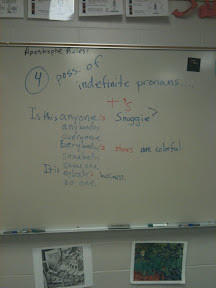
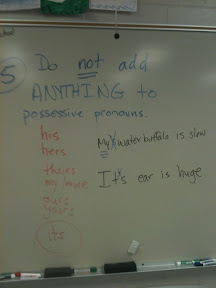
Here are two pics of rules 4 and 5:


Homework:


Finish exercises 2, 3, and 4 AND write 10 example sentences, 2 for each of the five rules.

Monday, April 11, 2011

Finishing Persuasive Speeches!

Tuesday we will finish the persuasive speeches!  On Wednesday, we will find out the class winners.  On Thursday, there will be a pod finale, in which the two best from each class will compete for the top three speakers in the pod!

Thursday, April 7, 2011

Hi Kids,

Today we took a vocabulary quiz.  If you were absent, you are responsible to take it tomorrow during a study hall.

Tomorrow we are watching The Alamo, so there will be shortened classes.

Homework: For those who have delivered their speech: None!  For those who haven't: practice your speech!

Monday, April 4, 2011

Persuasive Speech Delivery

Tomorrow we will begin delivering the persuasive speeches!  You now know what order you are delivering your speech, so when your day is up, come prepared and dressed nicely!  Bring your rubrics to class as well!

The vocabulary quiz has been moved to Thursday.